During the dark and chaotic years of World War II, one phrase began to appear everywhere—on bunker walls, ship hulls, ammunition crates, and bathroom doors alike:
“KILROY WAS HERE.”
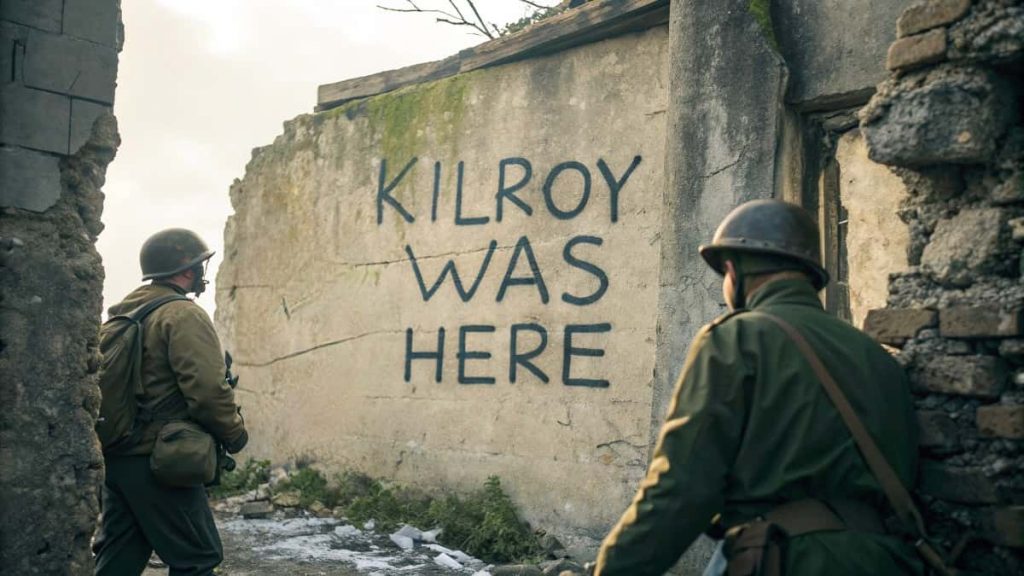
Next to it, a simple cartoon face peering over a line, with a big nose and curious eyes. It wasn’t just a doodle—it was a declaration. A whisper amid the noise of war saying, I was here.
A Spark of Humor in the Midst of War
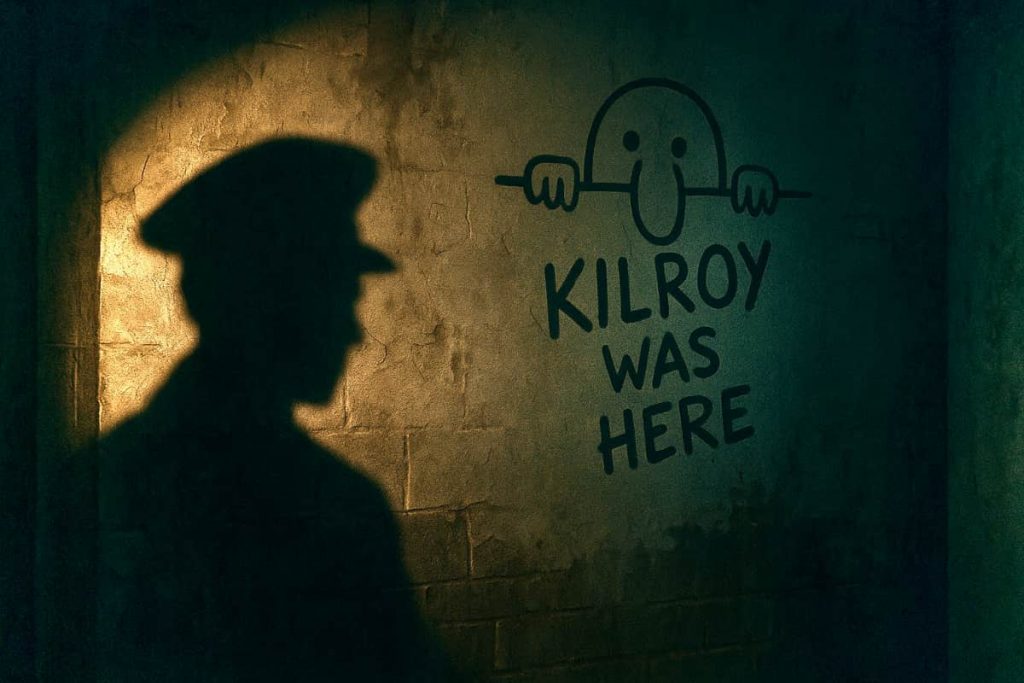
The story, as it’s most often told, begins with James J. Kilroy, a shipyard inspector from Quincy, Massachusetts. While checking rivets on warships, Kilroy used to leave the chalk note “Kilroy was here” to mark sections he had inspected. Those marks traveled with the ships across the ocean, eventually reaching distant battlefields.
Meanwhile, across the Atlantic, the British were drawing their own version of the same idea: a bald, long-nosed character named Mr. Chad peering over a wall, with captions like “Wot! No Tea?” or “Wot! No Cigs?” It was only a matter of time before the American phrase and the British figure merged into one universal wartime emblem—a humorous signature scrawled on every imaginable surface from Normandy to Okinawa.
Soon, no matter where soldiers went, Kilroy had already been there. On barrack doors, tank panels, and latrine walls, he was the invisible companion of millions.
The Anonymous Signature of the Soldier
“Kilroy was here” was not an order, not a slogan, not propaganda. It was something far more personal—and paradoxically, anonymous. Every soldier could write it; none could truly claim it.
For those in the trenches, writing those words meant more than leaving a mark. It meant: I survived this moment. I exist.
In the face of death and destruction, the phrase became a small act of defiance—proof of life etched into the machinery of war. Seeing it in a ruined building or on the side of a ship meant someone else, perhaps just like you, had stood there before.
Humor became endurance. A simple joke turned into a psychological anchor—a reminder that no one was entirely alone.
The First Viral Symbol
Long before the internet, Kilroy was the first “meme.”
It spread without technology, without media—only through human connection.
Each new inscription repeated the same joke, but together they formed a powerful symbol of shared experience.
It was how an entire generation of soldiers, scattered across continents, silently communicated: We are still here.
A Quiet Legacy After the War
When the war ended, Kilroy came home—but he didn’t disappear.
He reappeared in pop culture: in the 1983 Styx album Kilroy Was Here, in films, comics, and murals.
He was carved, quite literally, into the marble of the U.S. World War II Memorial in Washington, D.C.—hidden on both the Atlantic and Pacific sides, waiting to be discovered by visitors.
Other cultures had their own echoes: “Mr. Chad” in Britain, “Foo was here” in Australia, “Vasya was here” in the Soviet Union. All told, the impulse was the same—humans leaving behind proof of their fleeting existence.
“I Was Here”: The Oldest Human Instinct
“Kilroy was here” is not merely graffiti—it’s the continuation of something ancient.
From cave handprints to Roman inscriptions, humans have always needed to say I was here.
It is a paradoxical urge: to fight impermanence by leaving something permanent behind.
In that sense, Kilroy was not just a soldier’s joke but a timeless expression of humanity’s will to be remembered.
Written in chalk, paint, or pencil, on the cold surface of war, it still whispers the same message:
I lived. I existed. I left a mark.
References and Further Reading
- Atlas Obscura. (t.y.). Kilroy Was Here.
https://www.atlasobscura.com/places/kilroy-was-here - Mental Floss. (2013, 3 Temmuz). What’s the Origin of “Kilroy Was Here”?https://www.mentalfloss.com/article/51249/whats-origin-kilroy-was-here
- National Park Service. (t.y.). Kilroy Was Here.
https://www.nps.gov/rori/learn/historyculture/kilroy-was-here.htm - ThoughtCo. (2019, 10 Temmuz). Who Was Kilroy and Why Was He Here? https://www.thoughtco.com/killroy-was-here-4152093
- Task & Purpose. (2020, 25 Kasım). The Story of Kilroy and Why He Was There. https://taskandpurpose.com/history/the-story-of-kilroy-and-why-he-was-there
- Wikipedia. (2024, 5 Mart). Kilroy was here. Erişim adresi: https://en.wikipedia.org/wiki/Kilroy_was_here
- WBUR. (2021, 1 Ekim). How ‘Kilroy Was Here’ Became the First Meme. https://www.wbur.org/endlessthread/2021/10/01/memes-kilroy