Memento Mori: Remember That You Will Die and Live with Meaning

Among all Latin phrases that echo through history, few carry as much philosophical depth as “Memento mori.”Literally meaning “Remember that you will die,” this expression serves as a timeless reminder of mortality and the fleeting nature of life.
Historical Origins
The phrase dates back to Ancient Rome. During triumphal parades, victorious generals would ride through the streets while a slave stood behind them whispering:
“Respice post te! Hominem te esse memento! Memento mori!”
(“Look behind you! Remember you are only a man! Remember that you will die!”)
This ritual served to temper pride, reminding even the most powerful that glory and life itself are temporary.
Philosophical Meaning
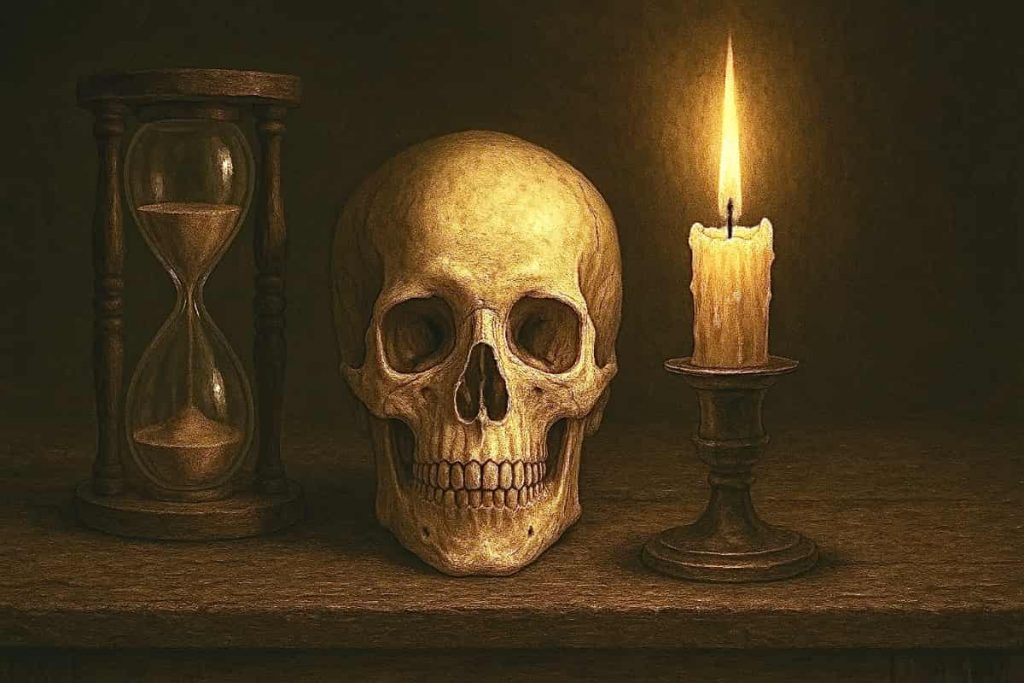
In Stoic philosophy, memento mori is not a morbid obsession but a path to wisdom and awareness. By acknowledging death, one learns to live fully, without vanity or excess ambition.
The Stoic emperor Marcus Aurelius, in his Meditations, wrote:
“Think of yourself as dead. You have lived your life. Now take what’s left and live it properly.”
The idea resurfaced in Medieval and Renaissance art, especially in vanitas paintings where skulls, hourglasses, and wilting flowers symbolized life’s transience. Such imagery encouraged viewers to reflect on what truly matters.
Modern Interpretations
Today, memento mori continues to inspire artists, philosophers, and even mindfulness practitioners. Rather than depressing, it is liberating — a reminder that life is finite, and therefore, every moment is precious.
In the words of existential psychiatrist Irvin D. Yalom, contemplating death can awaken us to the urgency of living authentically. “Memento mori” thus stands not as a call to despair, but as a call to live with purpose.
References
- Aurelius, M. (1997). Meditations (Trans. G. Long). Dover Publications.
- Barasch, M. (2001). Theories of Art: From Plato to Winckelmann. Routledge.
- Kreeft, P. (1988). Back to Virtue: Traditional Moral Wisdom for Modern Moral Confusion. Ignatius Press.
- Park, K. (2016). “Memento Mori and the Medieval Mind.” Journal of Medieval History, 42(3), 241–259.
- Yalom, I. D. (2008). Staring at the Sun: Overcoming the Terror of Death. Jossey-Bass.